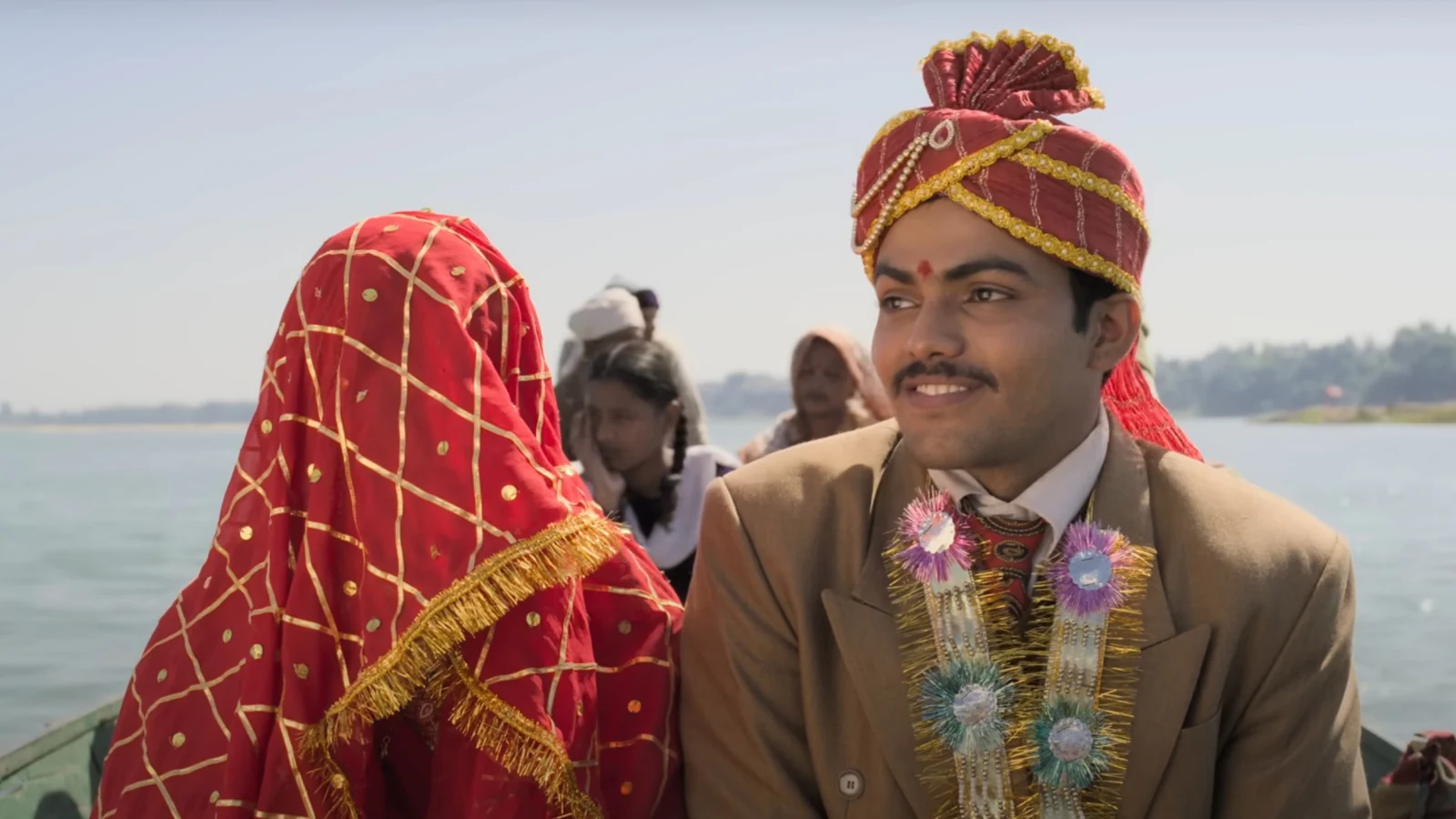

While there has always been an argument if men write better women characters or it’s the other way around, Kiran Rao easily and much gracefully goes ahead to write some of the best female and male characters in her latest release, “Laapata Ladies”! Her earnest effort to create a cinematic brilliance not only meets the desired purpose but ends up being an exemplary portrayal of lifting the veil on patriarchy with a sharp social satire.
Rao’s return to filmmaking after 14 long years must be applauded for the amazingly observant written skills (by the duo Biplab Goswami and Sneha Desai) and her character selection who play their parts straight from the heart. The rustic dramedy showcases a fictional village Nirmal Pradesh wherein invisibilization of a woman’s opinions, choices, likes and dislikes is conspicuous just like how patriarchy and misogyny is. This is well pronounced in the words of Deepak one of the male protagonist’s mother (a nameless character) who is astounded to know that women too should cook as per their likes. However not once does Kiran Rao make it preachy. Nirmal Pradesh which is one of those areas in India that uncannily shares a close cultural boundary with the so-called “cow belt” portrays gender discrimination as a way of life. But at every stage Rao peels off the layers of an unjust society and addresses such pressing issues with a light touch of satire and sarcasm that’s sprinkled liberally throughout the film.
Laapata Ladies is a story wherein two newlywed brides get swapped due to the long veil that covers their head resulting in one of the husbands, Deepak Kumar mistakenly taking the wrong wife home. The veil here has both literal and metaphorical manifestations that speaks about the position of women in a society wherein “Beti Bachao Beti Padao” was still a distant dream. The audience can easily relate to the milieu where a politician promises to take the next election from “‘vikas se vijay ki or’ (from development to victory) but girls and women fail to voice their opinion or even aspire for higher education. No wonder, Jaya one of the newlyweds cuts through this iron curtain of the society and sneaks out of it like a tiny sliver of grass thus giving hope to many who dare to dream against all odds. On the contrary is Phool, the other newlywed who finds herself burdened under the age old dictum of labeling woman as good or bad basis their domestic acumen. She prides in her upbringing that’s taught her to hold onto her marital status even at the onset of adversity. No wonder one sees Phool hiding behind a huge dustbin that surprisingly screams off “Use Me” in bold letters. Just when she finds herself basking in the glory of a “bhale ghar ki ladki” (girl from a reputed family/household) there enters Manju Maai, an old yet strong, determined and fiercely independent tea-stall owner who tries to drive some common sense or rather absolutely brilliant life lessons into the head of innocent and naive Phool. Manju Maai seems the voice of rationality or rather Rao herself talking about what should be rather than what is. The conversation between Manju Maai and Phool is a beautiful revelation of different ideologies yet none of it seems out of place or too much into your face making you recollect the closing credits that has a beautiful and apt line dedicated to yesteryear’s filmmaker Hrishikesh Mukherjee, “I never let the sugar in my films overpower the medicine.” This is a perfect line that quite sums up Rao’s Laapata Ladies since the film’s exhibition of the feminist stance is quite nuanced and is conveyed without beating the audiences over their heads.
While there has always been an argument if men write better women characters or it’s the other way around, Kiran Rao easily and much gracefully goes ahead to write some of the best female and male characters in her latest release, “Laapata Ladies”! Her earnest effort to create a cinematic brilliance not only meets the desired purpose but ends up being an exemplary portrayal of lifting the veil on patriarchy with a sharp social satire.
Rao’s return to filmmaking after 14 long years must be applauded for the amazingly observant written skills (by the duo Biplab Goswami and Sneha Desai) and her character selection who play their parts straight from the heart. The rustic dramedy showcases a fictional village Nirmal Pradesh wherein invisibilization of a woman’s opinions, choices, likes and dislikes is conspicuous just like how patriarchy and misogyny is. This is well pronounced in the words of Deepak one of the male protagonist’s mother (a nameless character) who is astounded to know that women too should cook as per their likes. However not once does Kiran Rao make it preachy. Nirmal Pradesh which is one of those areas in India that uncannily shares a close cultural boundary with the so-called “cow belt” portrays gender discrimination as a way of life. But at every stage Rao peels off the layers of an unjust society and addresses such pressing issues with a light touch of satire and sarcasm that’s sprinkled liberally throughout the film.
Laapata Ladies is a story wherein two newlywed brides get swapped due to the long veil that covers their head resulting in one of the husbands, Deepak Kumar mistakenly taking the wrong wife home. The veil here has both literal and metaphorical manifestations that speaks about the position of women in a society wherein “Beti Bachao Beti Padao” was still a distant dream. The audience can easily relate to the milieu where a politician promises to take the next election from “‘vikas se vijay ki or’ (from development to victory) but girls and women fail to voice their opinion or even aspire for higher education. No wonder, Jaya one of the newlyweds cuts through this iron curtain of the society and sneaks out of it like a tiny sliver of grass thus giving hope to many who dare to dream against all odds. On the contrary is Phool, the other newlywed who finds herself burdened under the age old dictum of labeling woman as good or bad basis their domestic acumen. She prides in her upbringing that’s taught her to hold onto her marital status even at the onset of adversity. No wonder one sees Phool hiding behind a huge dustbin that surprisingly screams off “Use Me” in bold letters. Just when she finds herself basking in the glory of a “bhale ghar ki ladki” (girl from a reputed family/household) there enters Manju Maai, an old yet strong, determined and fiercely independent tea-stall owner who tries to drive some common sense or rather absolutely brilliant life lessons into the head of innocent and naive Phool. Manju Maai seems the voice of rationality or rather Rao herself talking about what should be rather than what is. The conversation between Manju Maai and Phool is a beautiful revelation of different ideologies yet none of it seems out of place or too much into your face making you recollect the closing credits that has a beautiful and apt line dedicated to yesteryear’s filmmaker Hrishikesh Mukherjee, “I never let the sugar in my films overpower the medicine.” This is a perfect line that quite sums up Rao’s Laapata Ladies since the film’s exhibition of the feminist stance is quite nuanced and is conveyed without beating the audiences over their heads.
Rao’s characterization of the two husbands (whose newlyweds are swapped) Deepak Kumar and Pradeep is equally brilliant; while the former is progressive in his thoughts and approach the latter finds himself chained in patriarchy and a deep rooted misogyny that he prides himself on. The juxtaposition of their perspectives is beautifully etched just as the one between Jaya and Phool.
When talking about the characters one cannot miss Superintendent of Police Shyam Manohar (played by Ravi Kishan) whose palms are greasy but that grease has somehow not tarnished his conscience thus when Jaya reveals her ultimate desire to pursue higher education which is also the reason why she keeps evading the clasp of the chauvinist Pradeep, he yields into this wholeheartedly. Shyam Manohar truly wins our heart while being both greedy and just at the same time.
Laapata Ladies is full of memorable moments yet the social message isn’t overbearing. The film doesn’t overshadow the entertainment quotient rather it upholds it while using humor to reflect upon the deep-seated patriarchy and its repercussions. Rao’s lighthearted story telling is a great case study for women empowerment, education and gender equality without discrediting the men or succumbing to common prejudices thus one hears Pradeep’s mother’s snarky comment at a liberal Deepak saying, “Dowry nahi liya toh ladke mein khot hogi.”
The audience can easily see through the flawed characters yet they can’t help liking them. One of the most memorable scenes in the film is when Manju Maai reveals that living alone is respectable than tolerating domestic violence and abuse thus summing up one of the most beautiful lines, “If those who love you have the right to hit you, I exercised my right too” stands up to be the mic drop moment. So does Deepak’s response to Jaya’s apology, “Never apologize for daring to dream” goes onto shatter the patriarchy eventually.
Kiran Rao’s Laapata Ladies tramples age old narratives like ‘a girl is never smart, she is over smart’ or even ‘ a woman is not clever, she is cunning’. It goes onto prove that a “respectable girl” is the biggest fraud in the Indian society as it stops women from challenging or questioning the status quo. Rao doesn’t make her women play the victim card either rather she tells them to believe that “It’s not shameful to be a fool but being proud of one’s ignorance is a shame” as if it’s time that some things are better said loud and clear rather than hidden and/or “veiled”.
it’s time that some things are better said loud and clear rather than hidden and/or “veiled”.



























No Comments
Leave a comment Cancel